

multilayer PCB interface
Multilayer PCB Interface: Design and Functionality A multilayer printed circuit board (PCB) interface is a critical component in modern electronics, enabling high-speed signal transmission, power distribution, and connectivity between multiple layers of a PCB. Multilayer PCBs consist of several conductive layers separated by insulating dielectric materials, interconnected through vias, pads, and traces. The interface design ensures reliable communication between different layers while minimizing signal loss, crosstalk, and electromagnetic interference (EMI). Key Features of Multilayer PCB Interfaces 1. Layer Stackup and Signal Integrity The layer stackup defines the arrangement of power, ground, and signal layers. A well-designed stackup reduces noise and maintains signal integrity by providing proper shielding and impedance control. High-speed signals often require controlled impedance traces and differential pairs to minimize reflections and skew. 2. Via Technologies Vias (through-hole, blind, buried, or microvias) facilitate vertical connections between layers. High-density interconnect (HDI) PCBs use microvias to enhance routing efficiency, especially in compact designs. Via stitching—placing multiple vias around critical traces—improves EMI shielding and thermal dissipation. 3. Power and Ground Planes Dedicated power and ground planes ensure stable voltage distribution and reduce loop inductance. Decoupling capacitors placed near ICs further enhance power integrity by suppressing high-frequency noise. 4. EMI and Crosstalk Mitigation Proper grounding techniques, such as split planes and guard traces, minimize EMI. Signal layers are often sandwiched between ground planes to reduce crosstalk. High-speed signals may require length matching and termination resistors to prevent signal degradation. 5. Thermal Management Thermal vias and copper pours help dissipate heat from high-power components. Multilayer PCBs in high-temperature applications may use thermally conductive materials to improve heat transfer. 6. Flexible and Rigid-Flex Interfaces Some multilayer PCBs incorporate flexible sections (rigid-flex designs) to enable dynamic interconnections in wearable or space-constrained devices. These require careful material selection to maintain durability and signal integrity. Applications Multilayer PCB interfaces are essential in advanced electronics, including: - High-speed digital systems (processors, FPGAs, memory modules) - RF and wireless communication (5G, IoT, radar systems) - Automotive and aerospace electronics (ECUs, avionics) - Medical devices (imaging systems, portable diagnostics) Conclusion A well-designed multilayer PCB interface ensures optimal performance, reliability, and manufacturability. By balancing signal integrity, power distribution, and thermal management, engineers can create robust solutions for complex electronic systems. Future advancements in materials and fabrication techniques will further enhance the capabilities of multilayer PCB interfaces.
Products
Category:
Board-to-Board Connectors
-
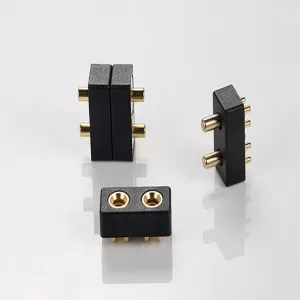
High-Density Board-Level Board-to-Board Connector
Category: Board-to-Board ConnectorsBrowse number: 2Number:Release time: 2025-12-29 15:51:48High-density board-level board-to-board connectors are designed to establish stable electrical connections between printed circuit boards within compact electronic assemblies. By enabling direct board stacking or parallel board integration, these connectors help reduce internal wiring, improve layout efficiency, and support modular system design.
News
Category:
-
[industry news]How FAKRA Connectors Improve Signal Stability in Automotive...
2025-12-30 08:56:32 -
[industry news]Common Challenges When Selecting Industrial Power Connectors
2025-12-30 08:58:49 -
[Company News]Designing Reliable Industrial Networks with M12 Connectors
2025-12-31 09:03:39 -
[Company News]Manufacturing and Inspection Process of Industrial Power Con...
2025-12-31 09:04:56 -
[Company News]How Push-Pull Connectors Improve Connection Stability in Por...
2026-01-02 09:03:07 -
[industry news]Board-to-Board Connectors Explained: Basics, Types and Appli...
2026-01-03 08:59:51 -
[industry news]Push-Pull Connectors vs Threaded Circular Connectors: Which...
2026-01-04 09:09:10
Case
Category:

Video
Category:
No search results found!
Download
Category:
No search results found!
Job
Category:
No search results found!
Featured Products
No search results found!



 Phone
Phone